Before Your First Patient: Prescribing Setup for a New PMHNP or Psychiatry Practice
Most start-up guides for a psychiatric practice cover the business entity, malpractice coverage, payer credentialing, and an EHR. Prescribing setup gets a single line, yet it runs through several agencies, and each step depends on the one before it. A practice can open on schedule and still be unable to send a controlled-substance prescription because one registration is still pending.
This guide puts the prescribing steps in order for psychiatrists and psychiatric-mental health nurse practitioners (PMHNPs) opening a practice, in person or by telehealth. It covers what each step requires, what it costs where the cost is published, and a checklist to finish before your first patient.
This is general information about regulations and software, not legal or clinical advice. Requirements vary by state and change over time, so confirm current rules with your state licensing board.
The order matters
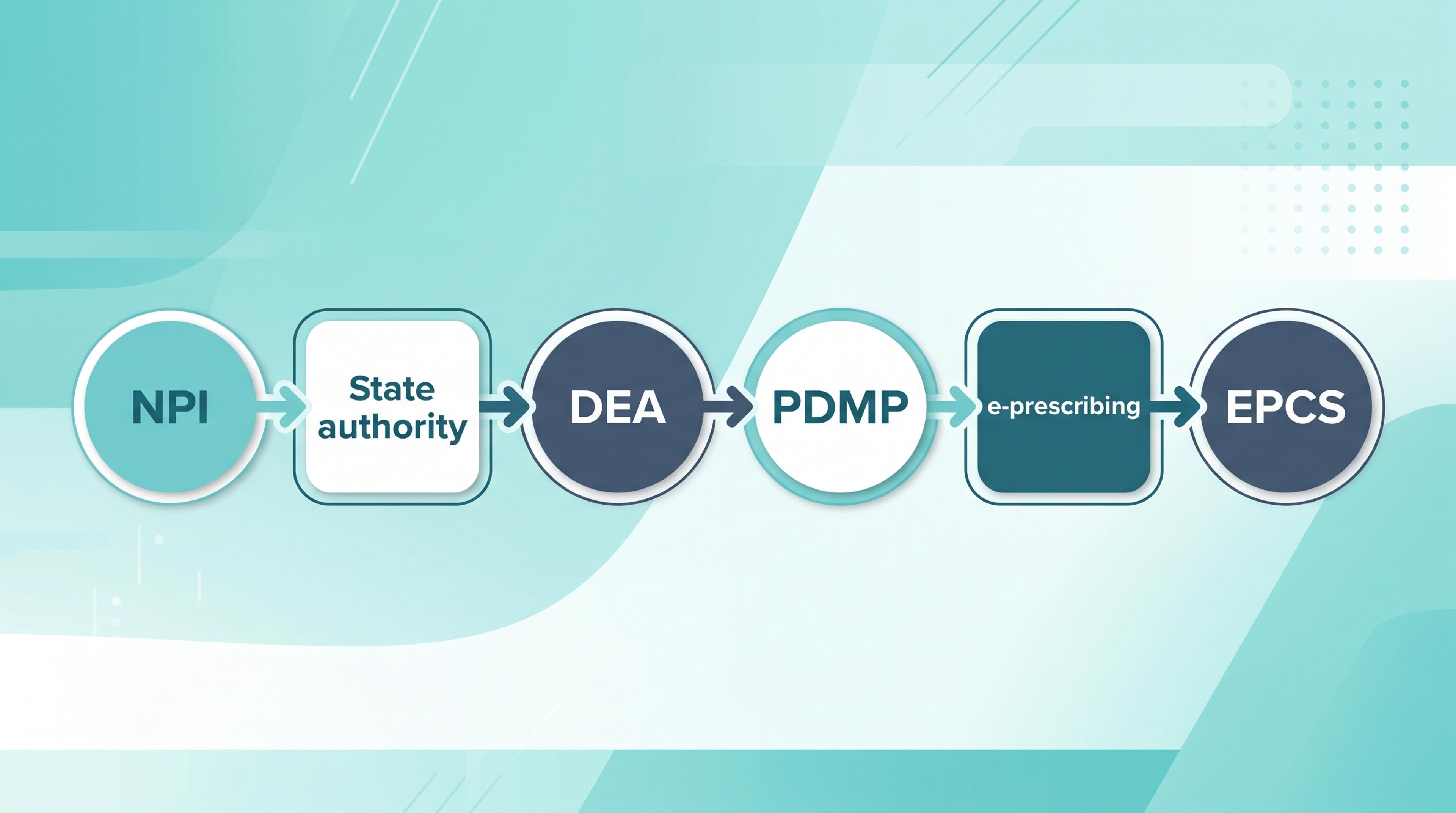
Federal rules allow a controlled-substance prescription only from a practitioner who is authorized by their state and registered with DEA (21 CFR 1306.03). Electronic prescribing of controlled substances (EPCS) in turn requires a verified DEA registration. So the sequence runs from state authority, to DEA, to EPCS.
Step by step
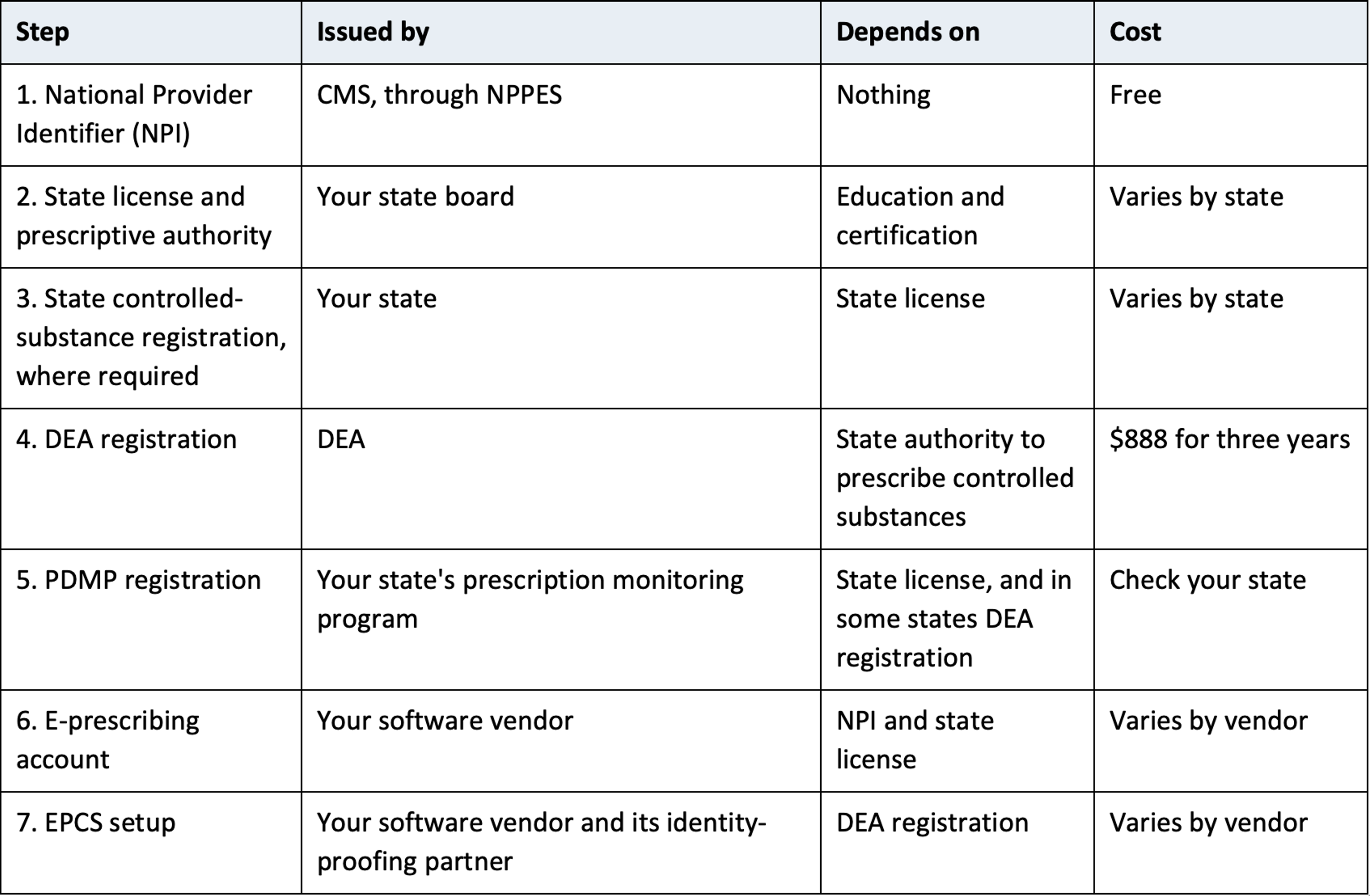
1. Get your NPI. Apply through CMS's NPPES system. An individual NPI (Type 1) is free and stays with you for your career. If you form a practice entity that bills under its own name, it will need an organizational NPI (Type 2) as well.
2. Confirm your state license and prescriptive authority. For psychiatrists, this is your medical license. For PMHNPs, it is your advanced practice license plus whatever your state requires before you prescribe, which in some states includes a separate prescriptive-authority approval or a collaborative agreement with a physician. Confirm which controlled-substance schedules you may prescribe. If you will practice with a collaborating physician, see Controlled-Substance Prescribing for NPs and Collaborating Physicians.
3. Get a state controlled-substance registration if your state requires one. Some states issue their own controlled-substance registration, separate from DEA, and DEA registration depends on having state authority in place. Check with your state board of pharmacy or licensing board before you apply to DEA.
4. Register with DEA. New practitioners apply on DEA Form 224 through DEA's Diversion Control Division. The fee is $888 for a three-year registration (Federal Register, July 2020). Three points to plan around:
- One registration per state. DEA registration is state-specific. If you will prescribe controlled substances in more than one state, plan on a registration in each.
- No prescribing until it is issued. You may not prescribe controlled substances until DEA grants the registration and issues the certificate (21 CFR 1301.13). DEA does not publish a guaranteed processing time, so apply as soon as your state authority is in place.
- One-time training attestation. Practitioners attest on their first DEA registration or renewal filed on or after June 27, 2023, that they have completed a one-time, eight-hour training on substance use disorders. Earlier buprenorphine waiver training counts toward it (DEA letter on the MATE Act training requirement).
5. Register with your state PDMP. Every state has a prescription drug monitoring program. Many require prescribers to register, and many require a check before prescribing certain controlled substances. Your state PDMP's website lists who must register and when a check is required.
6. Set up e-prescribing for non-controlled medications. A standalone e-prescribing account generally needs only your NPI and state license, so you can complete this step while DEA registration is pending. That lets you prescribe antidepressants, antipsychotics, mood stabilizers, and other non-controlled medications from the first day.
7. Set up EPCS. Once your DEA registration is verified, EPCS adds three things: identity proofing to a federal standard, a two-factor credential such as an authenticator app, and setup of who in the practice may do what. You must keep your signing credential to yourself and may not let anyone else use it to sign controlled-substance prescriptions (21 CFR 1311.102). For the full requirements, including CMS's EPCS measure for Medicare Part D and state mandates, see What EPCS Requires and Costs in 2026.
Telehealth practices
If you plan to prescribe controlled substances by telehealth, check DEA's current telemedicine rules before you open. Federal flexibilities that allow some telehealth prescribing without a prior in-person visit are temporary and currently extend through December 31, 2026 (Holland & Knight summary, January 2026). State rules also apply, and DEA registration generally needs to be in the state where you prescribe.
A prescribing budget
The prescribing-specific costs for a solo practitioner are modest next to an EHR or malpractice coverage.
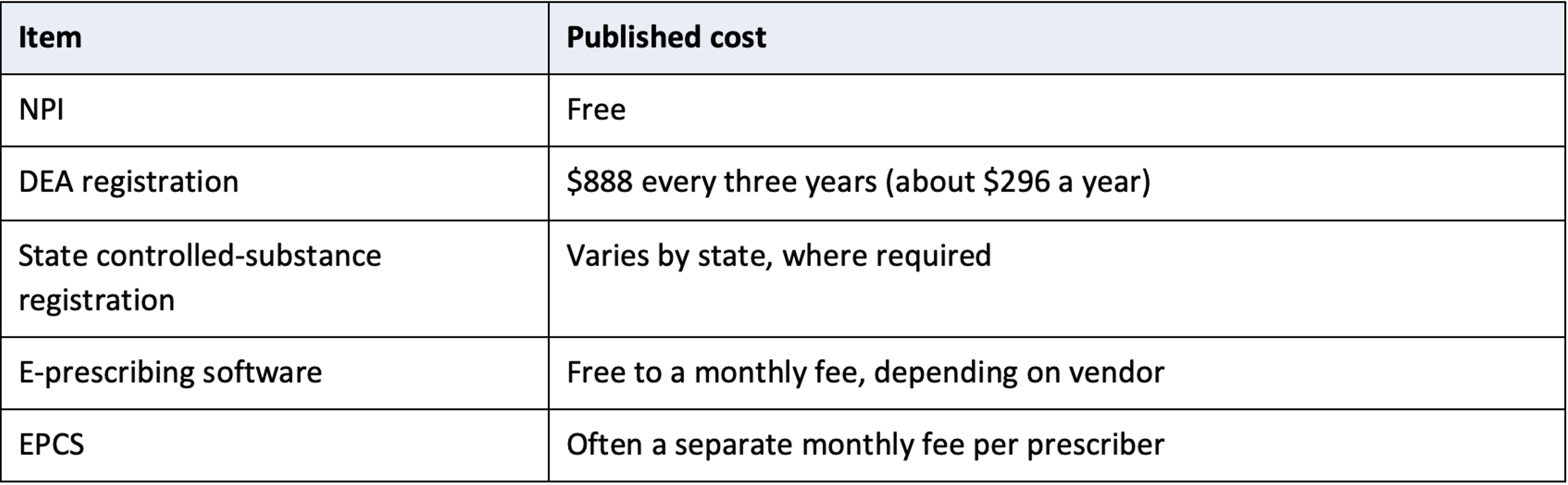
Before your first patient: a checklist
- NPI issued, and organizational NPI if your entity bills under its own name
- State license active, with prescriptive authority and controlled-substance schedules confirmed
- State controlled-substance registration issued, if your state requires one
- DEA registration issued for each state where you will prescribe controlled substances
- One-time DEA training attestation completed
- PDMP account active
- E-prescribing account verified and a test prescription workflow reviewed
- EPCS identity proofing and two-factor credential complete
- Intake form asks each patient for a preferred pharmacy
- A plan for where prescriptions and visit notes are documented
Where eNavvi fits
eNavvi is a standalone e-prescribing platform that works with or without an EHR. Signup needs your NPI and state license number, with no contract or credit card, and most state licenses are verified within an hour (eNavvi FAQ). The Core plan is free for non-controlled prescribing and includes price comparison across pharmacies, so you can complete step 6 while DEA registration is pending. You or your patient choose the pharmacy; eNavvi's pharmacy search does not rank or favor any pharmacy.
The EPCS add-on costs $20 per prescriber per month and is Drummond-certified for Schedules II through V, with identity verification and two-factor signing through Microsoft Authenticator. EPCS on eNavvi runs on desktop only (eNavvi pricing). For a step-by-step setup without an EHR, see How to E-Prescribe Without an EHR.
Questions new practice owners ask
Can I start prescribing before my DEA registration arrives? For non-controlled medications, yes, once your e-prescribing account is verified. Controlled substances must wait until DEA issues your registration and your EPCS setup is complete.
Do I need a DEA registration in every state where I see patients? Generally, DEA registration is required in each state where you prescribe controlled substances, including for telehealth. Check DEA's current guidance for your situation before prescribing across state lines.
Does the eight-hour DEA training apply if I don't treat substance use disorders? The one-time training attestation applies to DEA-registered practitioners generally, not only those who treat substance use disorders. See DEA's letter for what qualifies.
Can my staff send prescriptions for me? Staff can prepare a prescription for your signature (21 CFR 1306.05). For electronic controlled-substance prescriptions, only you can sign, using your own credential.
Do I need EPCS if I rarely prescribe controlled substances? It depends on your state and your Medicare Part D volume. Many states require electronic prescribing of controlled substances, and CMS has its own measure with an exception for small prescribers. See What EPCS Requires and Costs in 2026.
Next step
You can set up non-controlled e-prescribing today and add EPCS once your DEA registration is in place. eNavvi's pricing page lists the plans, and you can register for the free Core plan at enavvi.com.