503A vs. 503B Compounding: What Prescribers Need to Know Before Sending a Compound
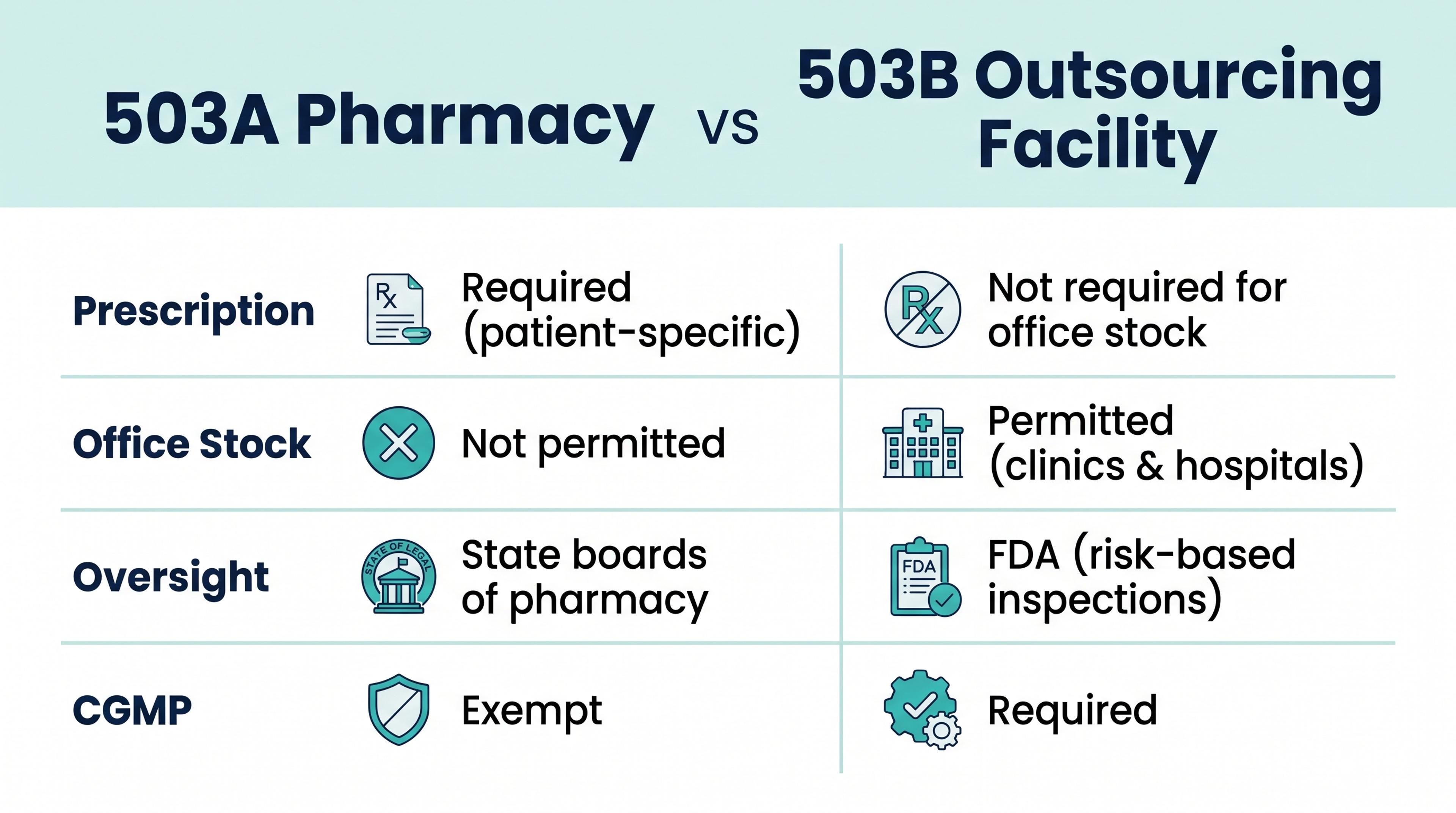
Compounding pharmacies in the United States operate under one of two federal frameworks, named for the sections of the Federal Food, Drug, and Cosmetic Act that define them. A 503A pharmacy compounds for individual patients based on a prescription. A 503B outsourcing facility is registered with FDA, follows manufacturing-grade quality standards, and can supply compounded products to clinics and practitioners for office use without a patient-specific prescription. Which one you use depends mostly on whether the compound is for a named patient or for your office.
This guide explains the difference, when each applies, what to ask a compounding pharmacy before you send a prescription, and how recent federal policy on peptides fits in.
This is general information about regulations, not legal or clinical advice. State rules on compounding vary, so confirm requirements with your state boards.
The short answer
503A: compounding for an individual patient
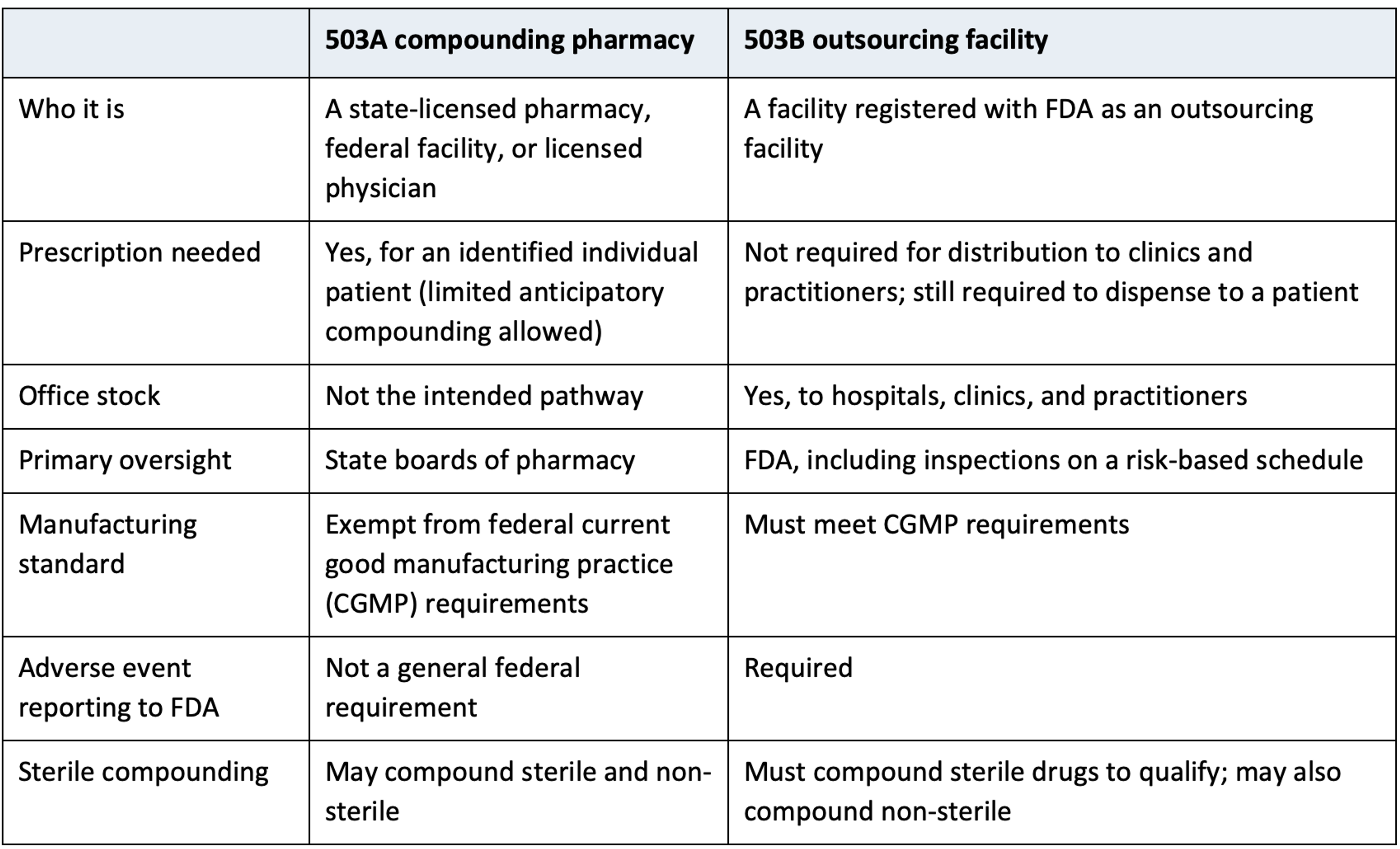
Under section 503A, a drug must be "compounded for an identified individual patient based on the receipt of a valid prescription order or a notation, approved by the prescribing practitioner, on the prescription order that a compounded product is necessary for the identified patient," and compounded by a licensed pharmacist in a state-licensed pharmacy or federal facility, or by a licensed physician (FDA guidance, Prescription Requirement Under Section 503A). A 503A pharmacy may also compound limited quantities in anticipation of prescriptions it routinely receives.
Most compounds prescribers send for a specific patient, such as a topical dermatology formula, a hormone preparation, or a flavored pediatric suspension, go to a 503A pharmacy. Because 503A pharmacies are licensed and inspected primarily by state boards, quality oversight depends heavily on the state and on voluntary accreditation.
A 503A pharmacy is also limited in what it can use. Bulk drug substances generally must have a USP or NF monograph, be a component of an FDA-approved drug, or appear on FDA's 503A bulks list (FDA Briefing Document, July 2026). FDA also restricts 503A pharmacies from regularly compounding drugs that are essentially copies of commercially available products (FDA guidance, Essentially Copies Under Section 503A).
503B: outsourcing facilities and office stock
Section 503B, added by the Drug Quality and Security Act in 2013, created outsourcing facilities. They register with FDA, must meet CGMP requirements, are subject to FDA inspection on a risk-based schedule, and must report adverse events. In exchange, they can distribute sterile and non-sterile compounded products to hospitals, clinics, and practitioners for office use without first receiving a prescription for a named patient. They still cannot dispense a prescription drug directly to a patient without a prescription (FDA guidance, Prescription Requirement Under Section 503A).
FDA's guidance is direct on office use: hospitals, clinics, and practitioners can obtain non-patient-specific compounded products from registered 503B outsourcing facilities. If you keep compounded products in the office to administer to patients who need them immediately, such as certain injectables or procedural preparations, a 503B facility is the intended source.
FDA maintains a public record of outsourcing facility inspections, recalls, and other actions on its compounding inspections page.
Which one should you use?
A compound for one named patient: typically a 503A pharmacy, by prescription. A 503B facility may also fill patient-specific prescriptions if state and federal law allow.
A compound you will keep in the office and administer: a 503B outsourcing facility.
A sterile compound where manufacturing-grade quality matters: consider whether a 503B source exists, since 503B facilities must meet CGMP. If you use a 503A pharmacy, ask about its sterile compounding standards and accreditation.
One of the six peptides covered by HHS's October 2026 policy: only 503A compounding for an individual patient is within that policy; 503B is not.
What to ask a compounding pharmacy
Whichever type you use, these questions separate well-run pharmacies from the rest:
- Licensure where your patient lives. If the pharmacy ships across state lines, is it licensed or registered in the patient's state?
- Accreditation. Is it accredited for the type of compounding you need? The Pharmacy Compounding Accreditation Board (PCAB), administered by ACHC, accredits non-sterile, sterile, and hazardous-drug compounding separately.
- Standards followed. Does it follow USP chapters 795 (non-sterile), 797 (sterile), and 800 (hazardous drugs) as applicable?
- Ingredient sourcing. Where do its bulk ingredients come from, and does it receive a certificate of analysis for each lot?
- Testing and beyond-use dates. How does it test potency and sterility, and how does it assign beyond-use dates?
- Inspection history. For a 503B facility, check FDA's inspections and actions page. For a 503A pharmacy, check your state board's records.
- How it receives prescriptions. Can it receive structured electronic compound prescriptions, or only fax and order forms?
Sending compound prescriptions electronically
Compound prescriptions have traditionally traveled by fax or pharmacy order form. The e-prescribing standard now supports structured compound prescriptions with each ingredient and quantity as separate fields. eNavvi captures patient-specific compound prescriptions as structured ingredients rather than free text, for the compounding pharmacy that you or your patient choose; its pharmacy search does not rank or favor any pharmacy (eNavvi FAQ).
eNavvi's existing prescriber guides cover specific compounding areas, including compounded HRT, compounded dermatology medications, and compounding and GLP-1 agonists.
Questions prescribers ask
Are compounded drugs FDA-approved? No. Compounded drugs from either a 503A pharmacy or a 503B outsourcing facility are not FDA-approved. FDA does not review them for safety, effectiveness, or quality before they are marketed.
Can a 503A pharmacy supply my office with stock? FDA's guidance points practitioners to registered 503B outsourcing facilities for non-patient-specific office stock. Some states have their own rules, so check with your state board.
Is a 503B product always higher quality? 503B facilities must meet CGMP requirements and are subject to FDA inspection and adverse event reporting, which provide greater assurance of quality. Individual facilities still vary, so check inspection history.
Does the type of pharmacy change how I write the prescription? For a patient-specific compound, the prescription should identify the patient and fully specify the formula: each ingredient and strength, the base, the dosage form, the quantity, and the directions.
Next step
If you write compound prescriptions on fax forms today, eNavvi lets you enter each ingredient as a structured field instead of free text. If you don't use an EHR, see How to E-Prescribe Without an EHR. See the pricing page or register at enavvi.com.