4/13/2026
Compounded Finasteride, Minoxidil, and Beyond: A Prescriber’s Guide to Hair Loss Compounding
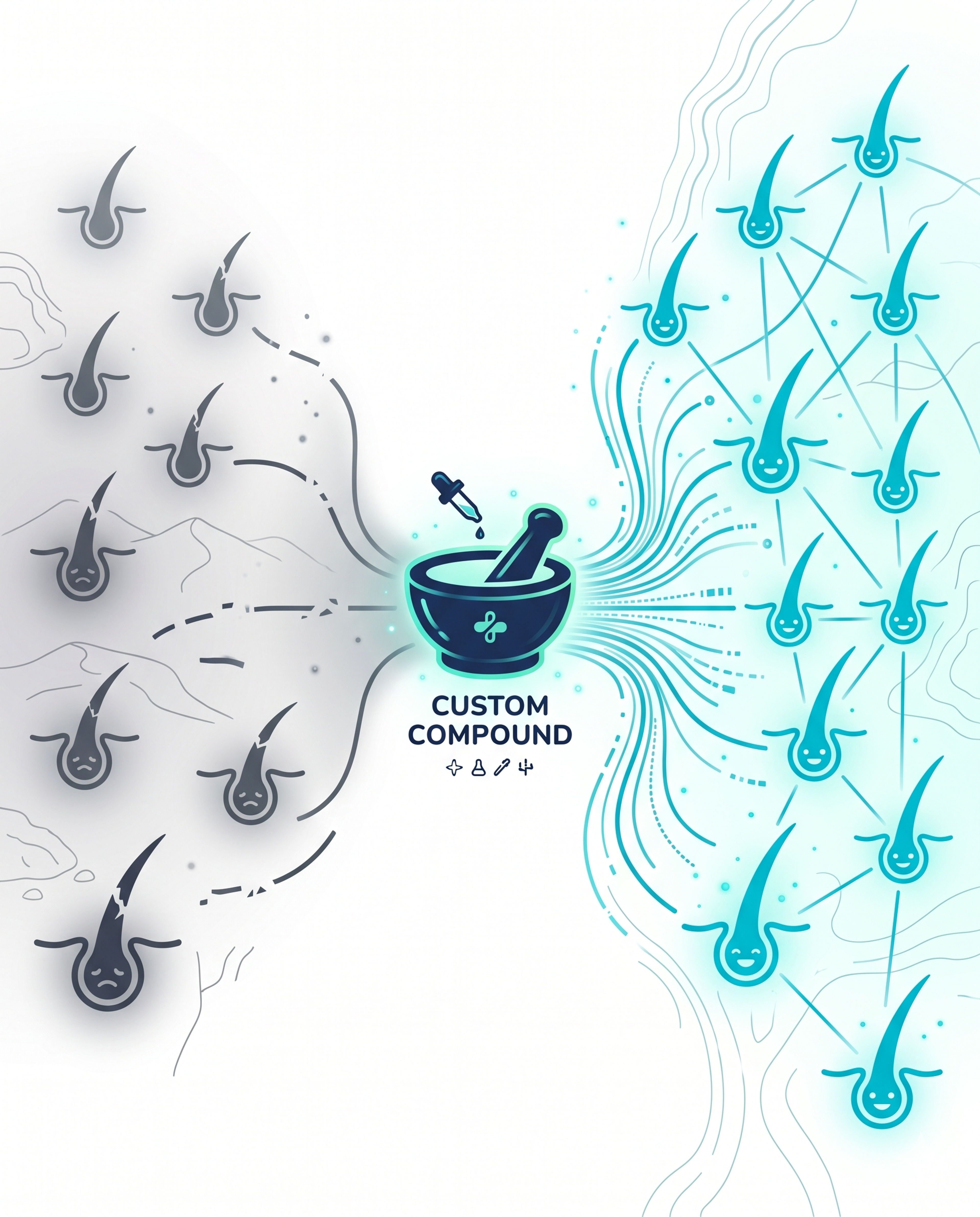
The hair loss treatment market is projected to reach $7.28 billion by 2032, and compounding pharmacies are an increasingly important part of that landscape. For prescribers, the shift is already obvious in the exam room: patients are arriving with questions about topical finasteride, compounded minoxidil formulations, and multi-agent combinations they found through telehealth platforms or social media. They want to know if these treatments actually work—and they want their physician, not an algorithm, to prescribe them.
The clinical case for compounded hair loss treatments is straightforward. FDA-approved products cover a narrow range of dosage forms and concentrations. Many patients need something different—a topical alternative to oral finasteride because of side-effect concerns, a higher-concentration minoxidil for treatment-resistant cases, or a multi-ingredient formulation that addresses several pathways at once. Compounding fills that gap. But prescribers need to understand what’s available, what’s supported by evidence, and what the FDA has flagged as a safety concern.
Why Commercial Hair Loss Products Don’t Fit Every Patient
The FDA-approved toolkit for androgenetic alopecia has been the same for years: oral finasteride (1 mg daily), oral dutasteride (0.5 mg, off-label in the U.S.), and topical minoxidil in 2% or 5% solutions or foam. These work—combined oral finasteride and minoxidil has shown a mean increase of roughly 30 hairs per square centimeter at 24 weeks in clinical studies—but they leave significant gaps.
Oral finasteride side effects. A meaningful percentage of male patients decline or discontinue oral finasteride due to sexual side effects (decreased libido, erectile dysfunction) or neuropsychiatric concerns (depression, anxiety, cognitive fog). These patients need a topical alternative—but there is no FDA-approved topical finasteride product on the market. The only pathway is compounding.
Concentration limitations. Over-the-counter minoxidil maxes out at 5%. Some patients—particularly those with treatment-resistant vertex thinning or diffuse thinning—respond better to higher concentrations (6%, 8%, or even 10% in some compounded formulations). Compounding pharmacies can also formulate minoxidil without propylene glycol for patients who develop contact dermatitis from the commercial vehicle.
Multi-pathway therapy. Alopecia is multifactorial: androgen-driven miniaturization, inflammation, microbial overgrowth, and vascular insufficiency can all contribute. A single-agent product addresses one mechanism. Compounded multi-agent topicals—combining a DHT blocker, a vasodilator, an anti-inflammatory, and an antifungal in one application—can address several pathways simultaneously, improving adherence by reducing the number of products a patient has to apply.
The Compounded Hair Loss Formulary: What Prescribers Should Know
Topical finasteride. The most-prescribed compounded hair loss ingredient. Typical concentrations range from 0.025% to 0.1% in solution or gel vehicles. The clinical rationale is straightforward: deliver the 5-alpha reductase inhibitor directly to the scalp to reduce local DHT while minimizing systemic absorption and its associated side effects. Patient satisfaction data from telehealth platforms has been positive, and a growing body of retrospective evidence supports efficacy. However, prescribers must be aware that the FDA issued a safety alert in April 2025 specifically addressing compounded topical finasteride. The agency noted 32 adverse event reports between 2019 and 2024—including erectile dysfunction, depression, and suicidal ideation—and emphasized that topical application does not eliminate systemic absorption. Patients must be counseled on these risks, and prescribers should document informed consent.
Topical minoxidil (compounded concentrations). Beyond the commercial 2% and 5% options, compounding pharmacies prepare minoxidil in concentrations from 6% to 15%, in vehicles ranging from solutions and foams to hydrating gels. Higher concentrations are typically reserved for patients who have plateaued on 5% or who have extensive thinning. Compounders can also formulate minoxidil without alcohol or propylene glycol—a meaningful advantage for patients with sensitive scalps or contact dermatitis.
Topical dutasteride. Dutasteride inhibits both type 1 and type 2 5-alpha reductase enzymes, making it a more potent DHT blocker than finasteride (which targets only type 2). Oral dutasteride is not FDA-approved for hair loss in the United States, though it is approved for this indication in South Korea and Japan. Topical dutasteride is available only through compounding, typically at concentrations of 0.01% to 0.1%. Long-term comparative data from Korea suggest dutasteride may outperform finasteride in sustained hair regrowth, and the topical route offers the same systemic-avoidance rationale as topical finasteride.
Latanoprost. A prostaglandin analog originally approved for glaucoma, latanoprost has shown the ability to increase hair density and prolong the anagen (growth) phase of the hair cycle. It is sometimes included in compounded multi-agent topicals. Clinical data is limited but promising—particularly for eyebrow restoration and frontal hairline thinning where traditional DHT blockers are less effective. Long-term scalp safety data is not yet available, so prescribers should use latanoprost as a targeted addition rather than a standalone therapy.
Ketoconazole. The antifungal agent ketoconazole has a dual role in hair loss compounding: it reduces Malassezia overgrowth on the scalp (a contributor to follicular inflammation and seborrheic dermatitis) and has demonstrated weak anti-androgenic properties. Most evidence supports its use as an adjunct ingredient in multi-agent formulations rather than a primary treatment. Compounded concentrations typically range from 1% to 2%, often combined with finasteride and minoxidil.
Spironolactone (topical). Topical spironolactone is an important compounded option for female pattern hair loss, where oral finasteride and dutasteride are contraindicated. At concentrations of 2% to 5%, topical spironolactone acts as a local anti-androgen without the systemic side effects (hyperkalemia, menstrual irregularity) associated with the oral form. Compounded formulations combining spironolactone, minoxidil, and tretinoin are increasingly common for female patients.
The FDA Safety Landscape: What Prescribers Cannot Ignore
Compounded hair loss formulations occupy a regulatory space that requires prescriber vigilance. None of these topical formulations are FDA-approved, which means the agency has not evaluated their safety, efficacy, or quality prior to marketing. That does not make them illegitimate—compounding under section 503A of the Federal Food, Drug, and Cosmetic Act is a well-established practice for patient-specific needs—but it does place an outsized responsibility on the prescriber and the pharmacy.
The April 2025 FDA safety alert on compounded topical finasteride is the most important recent development. The agency specifically noted that some patients were told by prescribers or telehealth platforms that topical application carried no risk of systemic side effects. That claim is inaccurate. Finasteride absorbs through the skin into the bloodstream, and topical use can produce the same adverse events reported with oral finasteride. The alert also raised concern about inadvertent transfer to household members—particularly women of childbearing potential, given finasteride’s teratogenic risk.
For prescribers, the takeaway is not to avoid compounded topical finasteride—it is to prescribe it responsibly. That means informed consent that mirrors the oral finasteride risk profile, explicit instructions on application technique and transfer prevention, documentation that the patient understands the off-label nature of the formulation, and selection of a PCAB-accredited compounding pharmacy that validates potency and ingredient quality. The quality of the pharmacy matters as much as the quality of the prescription.
Why Pharmacy Selection Is the Prescriber’s Most Underrated Decision
Hair loss compounding has exploded in the telehealth era. Direct-to-consumer platforms like Hims, Keeps, and Ro have introduced millions of patients to compounded finasteride and minoxidil—but the clinical oversight on those platforms varies enormously, and the compounding pharmacies behind them are not always transparent about their accreditation or testing protocols.
For physician-directed prescribing, pharmacy selection should be based on accreditation, not convenience. PCAB (Pharmacy Compounding Accreditation Board) accreditation means the pharmacy has been independently validated for potency testing, ingredient sourcing, beyond-use dating, and compounding consistency. When a prescriber sends a topical finasteride 0.05%/minoxidil 8% order to a PCAB-accredited pharmacy, there is a validated process behind the preparation. When the same order goes to an unaccredited pharmacy, there may not be.
This is where eNavvi changes the workflow. Rather than researching individual compounding pharmacies, calling to confirm formulation capabilities, and faxing prescriptions manually, prescribers can use eNavvi’s digital platform to browse pre-formulated hair loss templates across a network of PCAB-accredited compounding pharmacies—with transparent cash pricing visible before the prescription is sent. The patient gets a compounded product from a quality-validated source. The prescriber gets a workflow that doesn’t require a fax machine or a phone call. And both get pricing transparency that the telehealth platforms rarely offer.
Building a Hair Loss Compounding Workflow That Scales
Know the evidence—and its limits. Compounded hair loss formulations are supported by a growing body of retrospective data, case series, and real-world evidence. But they are not backed by the randomized controlled trials that FDA-approved products have undergone. Prescribers should present compounded formulations as clinically reasonable options within a shared decision-making framework, not as guaranteed solutions.
Document informed consent for topical finasteride. Given the FDA’s April 2025 alert, informed consent for compounded topical finasteride should cover systemic absorption risk, known side effects (sexual, neuropsychiatric), transfer risk to household members (especially women of childbearing age), and the non-FDA-approved status of the formulation. This is a clinical and medicolegal imperative.
Route prescriptions to accredited pharmacies. PCAB accreditation is the clearest signal of compounding quality available. For hair loss formulations—where potency variation directly affects outcomes and safety—sending prescriptions to an accredited pharmacy is not optional, it’s standard of care.
Digitize the workflow. Compounded hair loss prescribing should not mean a return to fax machines. eNavvi gives prescribers electronic access to a PCAB-accredited compounding network with hair loss formulation templates, transparent cash pricing, and a prescribing workflow that matches the efficiency of any EHR—without the limitation of being locked out of compounding pharmacies.
Frequently Asked Questions
Q: Is compounded topical finasteride safe?
A: Compounded topical finasteride uses the same active ingredient as FDA-approved oral finasteride but is not itself FDA-approved. The FDA issued a safety alert in April 2025 noting 32 adverse event reports (2019–2024) including erectile dysfunction, depression, and suicidal ideation. Topical application does not eliminate systemic absorption. Prescribers should counsel patients on these risks, document informed consent, and prescribe only from PCAB-accredited compounding pharmacies that validate potency and ingredient quality.
Q: What is the advantage of compounded hair loss formulations over commercial products?
A: Compounded formulations offer customizable concentrations (e.g., minoxidil above 5%), alternative delivery vehicles for patients with sensitivities, ingredients not available commercially as topicals (finasteride, dutasteride, spironolactone), and multi-agent combinations that address multiple hair loss mechanisms in a single application. This flexibility allows prescribers to tailor treatment to individual patient profiles rather than fitting every patient into the same two or three commercial products.
Q: How do I prescribe compounded hair loss treatments through eNavvi?
A: eNavvi provides a free digital prescription platform that connects directly to a network of PCAB-accredited compounding pharmacies. Prescribers can browse pre-formulated hair loss templates (topical finasteride, high-concentration minoxidil, dutasteride, multi-agent combinations), compare transparent cash pricing across pharmacies, and send compounded prescriptions electronically. No faxing, no phone calls, and no separate workflow for compounded versus FDA-approved medications.