9/25/2026
E-Prescribing for Solo Psychiatry and Psychiatric NP Practices: Stimulants, Benzodiazepines, and EPCS Without an EHR
If you run a small psychiatry or psychiatric nurse practitioner (PMHNP) practice, your prescribing needs differ from most other outpatient specialties in one way: controlled substances are often routine maintenance medications, not occasional exceptions. Most stimulants prescribed for ADHD are Schedule II. Benzodiazepines and many hypnotics are Schedule IV. Buprenorphine is Schedule III. A tool that handles non-controlled prescribing well but treats electronic prescribing of controlled substances (EPCS) as an afterthought will cost you time every week.
This article explains what a solo psychiatrist or PMHNP should look for in an e-prescribing tool, the federal rules that shape the stimulant and benzodiazepine workflow, what changes when you prescribe by telehealth, what EPCS costs on platforms small psychiatric practices commonly consider, and where a standalone tool like eNavvi fits.
This is general information about regulations and software, not legal or clinical advice. Requirements vary by state and change over time, so confirm current rules with your state licensing board.
The short answer
A small psychiatric practice needs four things from prescribing software: DEA-compliant EPCS for Schedules II–V, a workflow that handles Schedule II prescriptions without refills, a way to see medication cost before the patient reaches the pharmacy, and pricing that does not force you to buy a full electronic health record (EHR) just to prescribe. A standalone tool can provide all four, but verify each one rather than assume.
Why psychiatry's prescribing workflow is different
Three federal rules shape most of the difference. State law adds requirements on top of each.
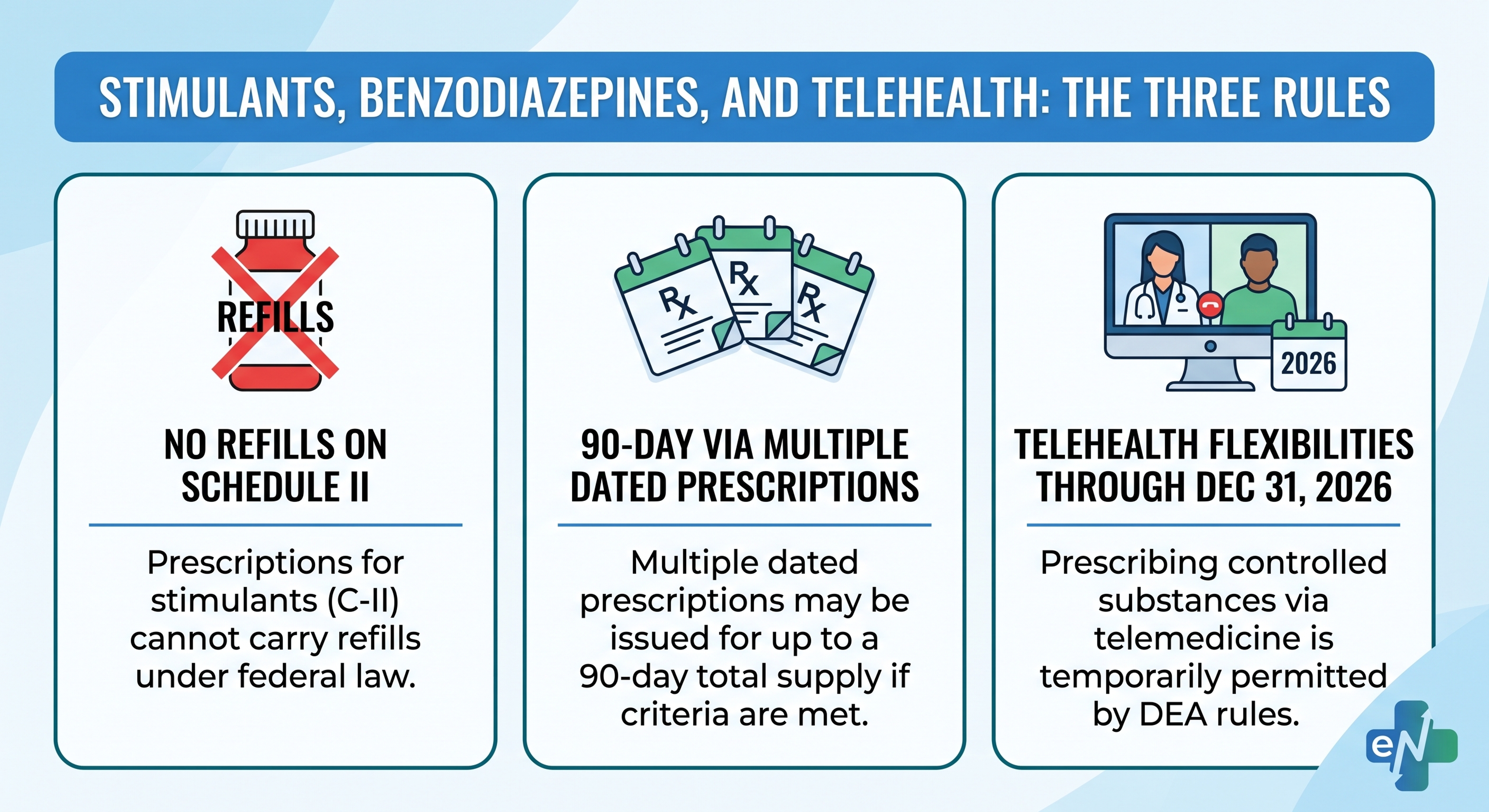
Schedule II prescriptions cannot be refilled. Under 21 CFR 1306.12(a), refilling a Schedule II prescription is prohibited. Every month of a stimulant is a new prescription, individually signed with two-factor authentication. Under 21 CFR 1306.12(b), a practitioner may issue multiple Schedule II prescriptions authorizing up to a 90-day total supply, but only if all of the following are met: each prescription is issued for a legitimate medical purpose by a practitioner acting in the usual course of professional practice; each prescription after the first carries written instructions stating the earliest date a pharmacy may fill it; the practitioner concludes that issuing multiple prescriptions does not create an undue risk of diversion or abuse; and the practice is permitted under applicable state law (21 CFR 1306.12). DEA has also stated that nothing in the rule requires a practitioner to issue multiple prescriptions or to see patients less often than sound medical judgment supports. Your software must support an earliest-fill-date instruction on each electronic prescription for this option to be usable at all.
Schedule III and IV prescriptions may be refilled, within limits. A Schedule III or IV prescription may be refilled no more than five times and may not be filled or refilled more than six months after the date it was issued; beyond that, a new prescription is required (21 CFR 1306.22). State law may be stricter.
EPCS requires identity proofing, two-factor signing, and personal accountability. DEA's rules require each prescriber to be identity-proofed by an approved credential service provider and to sign every controlled-substance prescription using two of three factors: something you know, something you have, or something you are (21 CFR 1311.115; DEA EPCS Q&A). The credential is personal: it may not be shared, a lost or compromised credential must be reported promptly, and the prescriber carries the same responsibility for an electronic prescription as for a paper one (21 CFR 1311.102). Staff may prepare a prescription, but only the prescriber may sign it. For a psychiatrist who signs controlled prescriptions many times a day, the speed of that second factor matters; an authenticator app on your phone is typically faster than a hardware token you have to locate.
Telehealth prescribing of controlled substances runs on temporary federal rules. Since 2020, DEA has allowed practitioners to prescribe controlled substances to patients seen by telemedicine under temporary flexibilities that it has extended several times, most recently through December 31, 2026, while it works on a permanent rule (Holland & Knight summary, January 13, 2026). State telehealth and prescribing laws apply separately and can be stricter. If your practice is telepsychiatry-based, check DEA's current telemedicine guidance and your state's rules before relying on telehealth prescribing, and check again before 2027.
Two state-level obligations sit on top of these. Most states require checking the prescription drug monitoring program (PDMP) before prescribing controlled substances, at intervals that vary by state. Many states also mandate EPCS for controlled substances, with their own exemptions. Neither is handled by the DEA rule, and neither is handled automatically by your prescribing software.
What a psychiatric NP needs to check first
For PMHNPs, the software question comes after the authority question. DEA classifies nurse practitioners as mid-level practitioners, and it states that a mid-level practitioner's authority to prescribe controlled substances, including which schedules, is determined by the state where they practice (DEA Diversion Control, Mid-Level Practitioners). A DEA registration does not expand what the state has granted.
As of May 2026, the American Association of Nurse Practitioners counts 27 states plus Washington, D.C. as full-practice environments, where NPs may prescribe medications and controlled substances under the exclusive licensure authority of the state board of nursing. Reduced- and restricted-practice states require a collaborative agreement, supervision, or delegation for at least one element of practice (AANP State Practice Environment, May 2026). Some states also limit which schedules an NP may prescribe, require additional registration, or require that a collaborative agreement specifically address controlled substances.
Before evaluating any tool, confirm with your state board of nursing that you hold controlled-substance prescriptive authority for the schedules you need, that any required collaborative or supervisory agreement is in place and covers controlled substances, and that your DEA registration is active and lists the correct practice location. Then confirm that the software accepts NPs as prescribers. Not every standalone tool does.
A workflow for stimulants and benzodiazepines
The steps below assume EPCS is already active. They describe how the software workflow can fit the rules above. They are not clinical guidance, do not establish a standard of care, and do not substitute for your own judgment or your state's requirements.
Stimulant renewals. For a patient you see monthly, each visit produces one Schedule II prescription. For a patient you see less often, federal rules permit up to three dated prescriptions totaling no more than a 90-day supply if the conditions in 21 CFR 1306.12(b) are met and your state allows it; some states limit or prohibit the practice. Whichever cadence you use, each prescription is dated on the day it is issued, signed individually with two-factor authentication, and preceded by a PDMP check at the interval your state requires. Document the check.
Supply-constrained stimulants. Methylphenidate extended-release and amphetamine mixed salts have appeared on federal or ASHP shortage lists at various points since 2022, and availability in 2026 still varies by manufacturer and dose (FDA Drug Shortages: methylphenidate ER). A prescription sent to a pharmacy that cannot fill it costs everyone time. Two options exist when that happens. Since August 28, 2023, DEA rules allow a pharmacy, at the patient's request, to transfer an unfilled electronic Schedule II–V prescription one time to another pharmacy for initial filling, pharmacist to pharmacist, without a new prescription (DEA, September 2023). Alternatively, the prescriber can cancel the original electronically (CancelRx) and issue a new one to a different pharmacy. If you reissue, cancel first, so the patient does not hold two active Schedule II prescriptions for the same medication. The choice of pharmacy remains the patient's.
Benzodiazepine tapers. Schedule IV prescriptions may carry up to five refills within six months under federal rules, but a taper is often written as a sequence of decreasing prescriptions rather than as a refillable one. A tool that lets you copy a prior prescription and edit the dose saves more time here than most features shown on a demo. Some states impose additional limits on benzodiazepine prescribing or co-prescribing with opioids; check yours.
The cost conversation. In the most-cited national data, 55.3% of office-based psychiatrists accepted private non-capitated insurance, compared with 88.7% of other office-based specialists, and more than half of office-based psychiatrists were in solo practice (Bishop et al., JAMA Psychiatry 2014, via PMC). That data is from 2009–2010, and a self-pay visit does not mean the patient lacks drug coverage. It does mean a cash-pay practice has no real-time benefit check running through a payer contract. Seeing pharmacy cash prices at the point of prescribing gives those patients a number to compare against their plan's price. Present any quoted price as an estimate: it depends on the pharmacy, the form, the quantity, and the moment of the quote, and the patient's insurance price may differ. The patient chooses the pharmacy; the price information is there to inform that choice.
What EPCS costs a small psychiatric practice
Psychiatry-focused EHRs and standalone tools price EPCS very differently, and the comparison is not like-for-like: an EHR includes charting, scheduling, and billing, while a standalone tool includes prescribing only. The table records what each vendor's public page stated when checked on September 24, 2026. Prices, plan contents, and trial terms change, so confirm with each vendor before deciding. Product names belong to their respective owners.
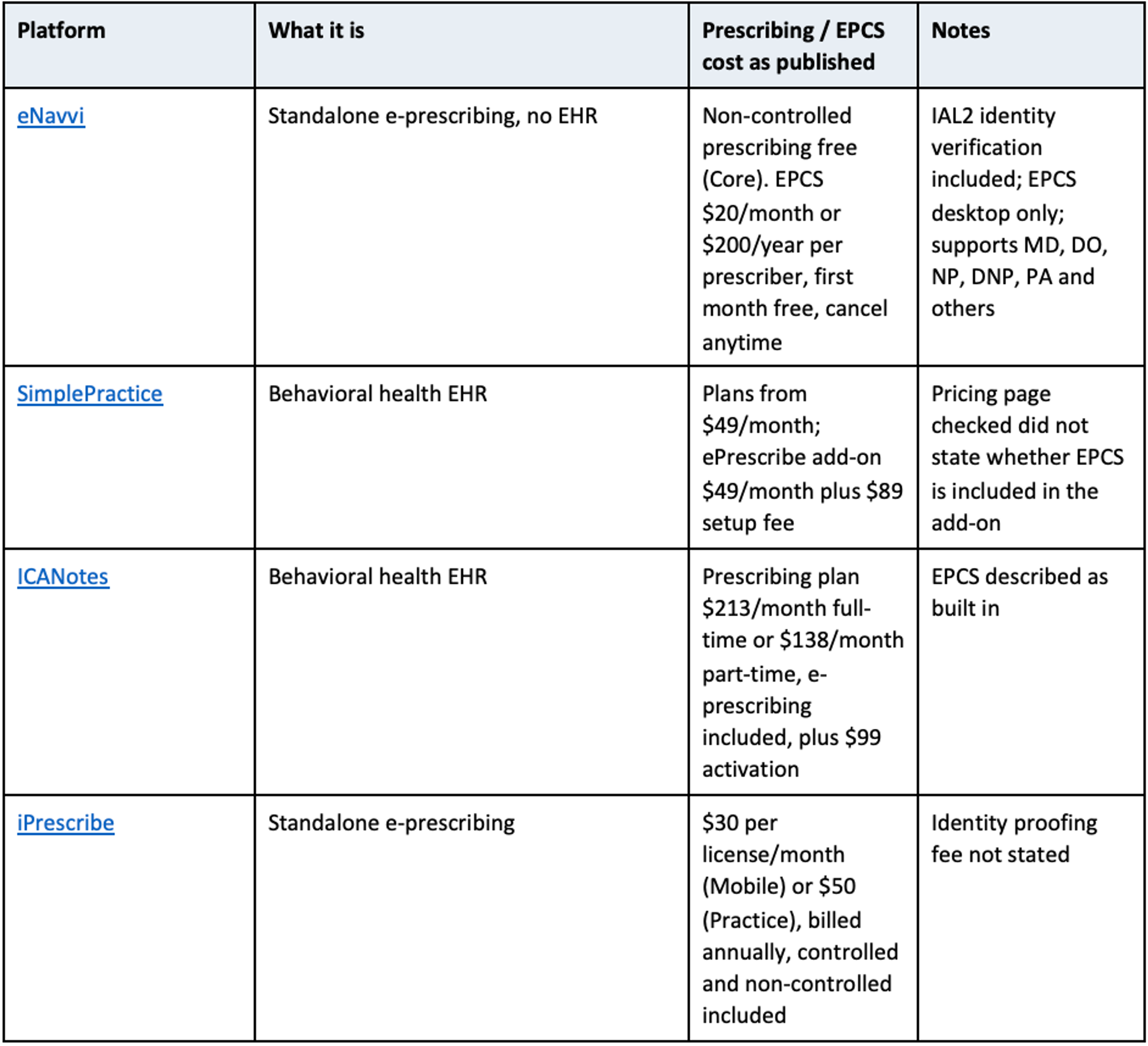
Two ways to read this. If you already have a system you like for notes and billing and only need prescribing, the standalone options on these published prices cost between $200 and $600 a year per prescriber before any add-ons. If you need an EHR anyway, the prescribing cost is embedded and the decision is about the EHR.
Where eNavvi fits for a psychiatric practice
eNavvi is a standalone e-prescribing platform. Its Core plan is free and covers non-controlled prescribing with real-time pharmacy price comparison, on desktop and mobile. Its EPCS plan costs $20 per month or $200 per year per prescriber after a one-month free trial, is Drummond-certified for Schedules II–V, uses IAL2 identity verification plus Microsoft Authenticator for two-factor signing, and transmits over the Surescripts network (eNavvi pricing). eNavvi supports MD, DO, NP, DNP, and PA prescribers, among others, and states that EPCS is available in every state (eNavvi FAQ). Under 21 CFR 1311.300, you may ask eNavvi, or any EPCS vendor, for its current third-party audit or certification report before you rely on the application.
Three limits worth knowing before you register. EPCS on eNavvi is desktop only, which fits telepsychiatry from a laptop but not signing a stimulant prescription from a phone between sessions. eNavvi is not an EHR: it does not store your progress notes or bill your visits, so you will document the prescription in whatever you use for charting. And like most e-prescribing tools, eNavvi does not replace your state PDMP check, which remains your responsibility at the interval your state requires.
For the general regulatory detail behind EPCS, see EPCS Without the EHR: A Guide for Small Dental and Psychiatric Practices.
Questions psychiatric prescribers ask
Can I prescribe stimulants by telehealth? Federal rules currently allow it under temporary flexibilities extended through December 31, 2026, and state rules vary. Check DEA's current telemedicine guidance and your state board before relying on telehealth prescribing for controlled substances.
Can I e-prescribe three months of a Schedule II stimulant at once? Federal rules allow multiple prescriptions totaling up to a 90-day supply, each dated on the day of issuance, each carrying an earliest-fill date after the first, and each signed individually, if you conclude there is no undue risk of diversion or abuse and your state permits it. Your software must support the earliest-fill-date instruction on each electronic prescription.
Does EPCS satisfy my state's PDMP requirement? No. EPCS is the DEA-compliant way to transmit the prescription. The PDMP check is a separate state obligation with its own timing and documentation rules.
As a PMHNP, does a DEA registration let me prescribe Schedule II? Only if your state grants that authority. DEA registration follows state scope of practice; it does not extend it. Confirm your schedule authority and any collaborative-agreement requirement with your state board before setting up EPCS.
My patient's pharmacy cannot fill the stimulant I sent. Do I have to write a new prescription? Not necessarily. Since 2023, federal rules allow the pharmacy, at the patient's request, to transfer an unfilled electronic controlled-substance prescription once to another pharmacy for initial filling. If you prefer to reissue it yourself, cancel the original first.
Next step
If you already have a way to chart and bill and want prescribing that costs nothing for non-controlled medications and $20 a month for EPCS, eNavvi's pricing page lists the details, and you can register for the free Core plan at enavvi.com. If you are a PMHNP, confirm your controlled-substance authority with your state board first.