9/30/2026
E-Prescribing for Dentists: What a Small Dental Practice Actually Needs, and What It Can Skip
Dentists are a distinct case in e-prescribing. Most dental prescriptions are short courses of antibiotics, NSAIDs, and a few other non-controlled medications. Opioid prescribing by dentists has fallen sharply, and the profession's own guideline now puts NSAIDs first for acute dental pain. Yet state e-prescribing mandates for controlled substances apply to dentists just as they do to physicians, and the practice-management software many dental offices run either lacks an e-prescribing module or prices one for a much larger practice.
This article covers what a small dental practice needs from e-prescribing software, how state mandates and low-volume exemptions generally apply to dentists, what dental-oriented e-prescribing costs, and how a standalone tool such as eNavvi fits alongside a dental practice-management system.
This is general information about regulations and software, not legal or clinical advice. Requirements vary by state and change over time, so confirm current rules with your state dental board.
The short answer
A dental practice needs an e-prescribing tool that connects to Surescripts for ordinary prescriptions, supports DEA-compliant EPCS for occasional Schedule II–IV prescriptions where your state requires it, accepts DDS and DMD prescribers, and doesn’t charge a full medical-EHR price for a practice that writes a handful of prescriptions a day. Whether it must integrate with your practice-management system depends on how much you value the prescription appearing in the chart automatically versus paying for the integration.
What dentists actually prescribe
Dental prescribing is low-volume and concentrated in a few categories. The controlled-substance share has been shrinking. In a JADA analysis of IQVIA prescription data covering 2015 to 2019, opioid prescriptions by U.S. dentists fell 34.4% overall; 14.8% of dentists wrote no opioid prescriptions, 46.0% were low prescribers, and 3.4% were consistently high prescribers (JADA, November 2023).
The American Dental Association's 2024 clinical practice guideline recommends NSAIDs, alone or with acetaminophen, as first-line treatment for acute dental pain in adults and adolescents 12 and older, and reserves opioids for limited circumstances with shared decision-making and attention to storage and disposal (ADA News, February 5, 2024). ADA policy since 2018 has also supported statutory limits of no more than seven days for opioids prescribed for acute pain (ADA, 2018).
The consequence for software selection: most dentists need EPCS rarely, but when they need it, they need it to work, and the state may require it. A tool that charges by prescription volume or bundles EPCS into an expensive medical EHR is a poor fit for this profile.
Do state e-prescribing mandates apply to dentists?
Generally yes. Many states require electronic prescribing of controlled substances, and those requirements apply to dentists as they do to physicians, with state dental boards typically responsible for enforcement. Most of these states also provide exemptions or waivers, and the details vary: some exempt prescribers who issue fewer than a set number of prescriptions a year, some grant time-limited waivers on application to the dental board or another agency, and some require exempt prescribers to register annually and continue using tamper-resistant paper. Your state dental board's website is the authoritative source for what applies to you.
Separately, the federal CMS EPCS Program requires prescribers to e-prescribe at least 70% of Schedule II–V controlled-substance prescriptions for Medicare Part D patients, with an automatic exception for prescribers who issue 100 or fewer qualifying Part D controlled-substance prescriptions in a year (CMS EPCS Program). A dentist whose Part D controlled-substance prescriptions stay at or below that number qualifies for the exception automatically, but the program applies to any prescriber whose prescriptions are filled under Part D, and it is separate from state requirements.
The practical reading: count your controlled-substance prescriptions for the last twelve months. If the number qualifies you for a state exemption, you have a choice. If it does not, or your state has no low-volume exemption, you need EPCS. An exemption that requires annual paperwork, paper prescriptions, and manual processes may cost more in staff time than a low-cost EPCS subscription, so compare both paths rather than assuming the exemption is cheaper.
Integrated module or standalone tool
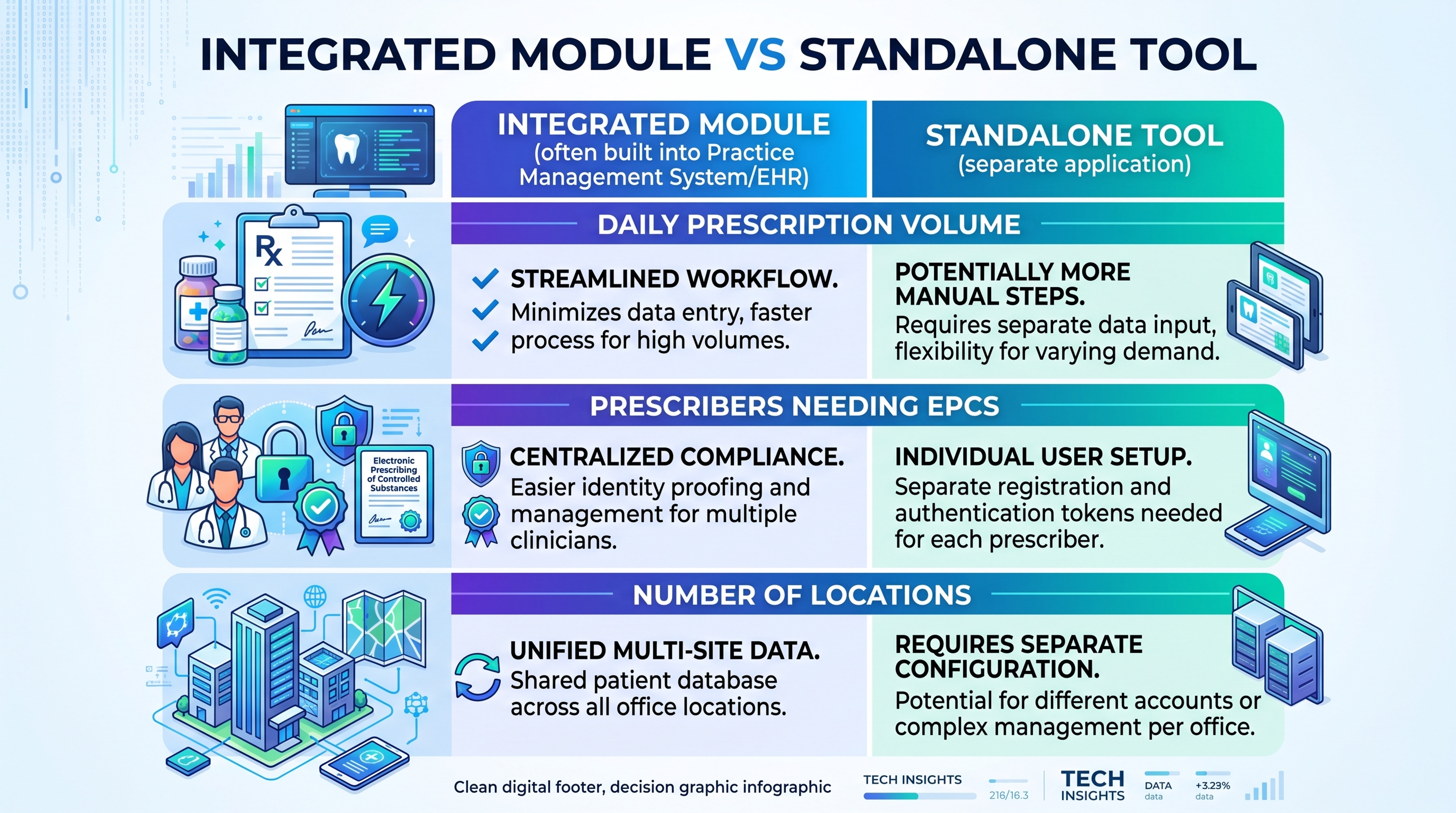
Dental practice-management systems such as Dentrix and Eaglesoft offer e-prescribing modules from their vendors. The advantage is that the prescription is written from the patient's chart and recorded there. The costs are less visible: the vendor pages checked for this article did not publish a monthly price for the module, and dental-association member offers describe their prices as discounts from a higher regular price.
A standalone tool works from a browser or app independent of the practice-management system. The tradeoff is documentation: you or your staff note the prescription in the chart rather than having it written there. For a practice writing a few prescriptions a day, that is a small habit. For a multi-dentist practice writing dozens, integration may be worth paying for.
Three questions settle it for most practices:
How many prescriptions a day does the whole practice write? Under about ten, standalone documentation is manageable. Above that, price the integration.
How many prescribers need EPCS? Every dentist who signs controlled prescriptions needs their own identity proofing and two-factor credential. Per-prescriber pricing multiplies quickly, so compare on total practice cost, not the headline number.
Do you prescribe from more than one location or from home? Browser-based standalone tools travel; some integrated modules are tied to the office installation.
What dental e-prescribing costs
The table records what each vendor's public page stated when checked on September 24, 2026, or on the date noted. It is a snapshot, not a ranking. Prices, plan contents, and trial terms change, so confirm with each vendor before deciding. Association member pricing is shown where that is the only published figure. Product names belong to their respective owners.
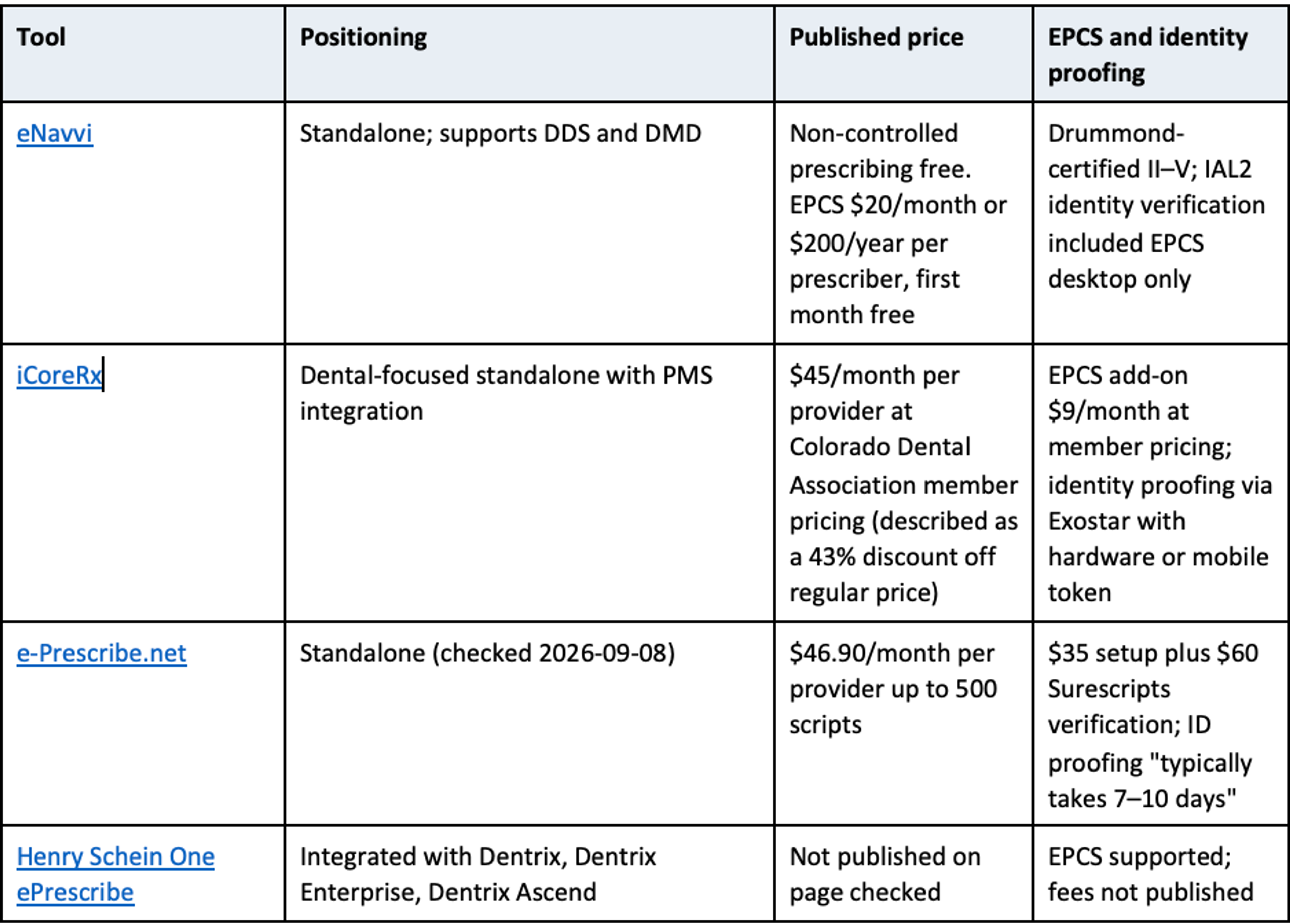
For a solo dentist who writes controlled prescriptions a few times a month, the twelve-month cost on published prices ranges from $200 to roughly $650 depending on the tool, before any practice-management integration fees. For a dentist who never prescribes controlled substances, at least one of these options is free.
A chairside workflow that fits dental practice
The steps below describe how e-prescribing software fits a dental visit. They are not clinical guidance and do not establish a standard of care; prescribing decisions remain yours.
Post-operative prescriptions. Write the NSAID or antibiotic while the patient is still in the chair, choose the pharmacy the patient names, and send it electronically. If the tool shows pharmacy prices, you can tell the patient roughly what a generic will cost before they leave. Cash prices for common generics can vary between nearby pharmacies, so the number is worth a sentence even when the drug is inexpensive. Present it as an estimate, since a quoted price depends on the pharmacy, quantity, and moment of the quote, and the patient's insurance price may differ. The patient chooses the pharmacy.
Antibiotic prophylaxis for a future appointment. Send the prescription with the pharmacy and the appointment date in mind so the patient has it filled before the visit. A tool with saved patient profiles and favorite prescriptions cuts this to seconds on the second visit.
The occasional controlled substance. Check the PDMP as your state requires, prescribe according to your judgment and any state limits on quantity or duration, and sign with two-factor authentication. If you use a standalone tool, note the prescription in the dental chart. Because EPCS on some tools, including eNavvi, is desktop only, keep a desktop or laptop available in the clinical area for these.
Associates and staff. Only a licensed prescriber may issue a prescription. Staff can prepare one for the dentist to review, but each dentist must have their own EPCS credential, may not share it, and must sign controlled-substance prescriptions personally (21 CFR 1311.102). Set user roles accordingly.
Where eNavvi fits for a dental practice
eNavvi is a standalone e-prescribing platform that runs from a browser or mobile app. The Core plan is free and covers unlimited non-controlled prescribing with real-time pharmacy price comparison. The EPCS plan costs $20 per month or $200 per year per prescriber after a one-month free trial, is Drummond-certified for Schedules II–V, includes IAL2 identity verification, and uses Microsoft Authenticator for two-factor signing (eNavvi pricing). eNavvi accepts DDS and DMD prescribers and states that EPCS is available in every state (eNavvi FAQ).
What it does not do: the Core and EPCS plans are standalone, so prescriptions are documented in your chart by hand; like most e-prescribing tools, it does not replace your state PDMP check; and EPCS is desktop only. For a small practice whose controlled-substance volume is low and whose main need is fast, inexpensive, compliant prescribing, those are usually acceptable limits. For a group practice that wants prescriptions written into the chart automatically, eNavvi's Enterprise plan lists EHR and practice-system integration at custom pricing. As with any EPCS vendor, you may ask eNavvi for its current third-party audit or certification report under 21 CFR 1311.300 before relying on the application.
For the general rules behind EPCS, see EPCS Without the EHR: A Guide for Small Dental and Psychiatric Practices.
Questions dentists ask
I only prescribe an opioid a few times a year. Do I still need EPCS? It depends on your state. Some states offer low-volume exemptions or waivers, usually with annual paperwork and continued paper-prescription requirements. Others do not. Check your state dental board, and weigh the cost of maintaining an exemption against a low-cost EPCS subscription.
Can my front-desk staff send prescriptions for me? Staff may prepare a prescription for you to review, but you must review and sign it, and for controlled substances you must sign with your own two-factor credential, which may not be shared.
Does e-prescribing software check the PDMP for me? Some tools offer a PDMP module; many do not. In either case, the legal duty to check at the intervals your state sets remains yours.
Do I need a full medical EHR to e-prescribe? No. Standalone e-prescribing tools work independently of any EHR or practice-management system. The DEA requirements for EPCS concern identity proofing, two-factor authentication, and certified software, not the presence of an EHR.
Next step
If your practice-management system does not include e-prescribing, or prices it for a practice larger than yours, eNavvi's Core plan is free for non-controlled prescriptions and EPCS is $20 a month per dentist. Details are on the pricing page, and you can register at enavvi.com.